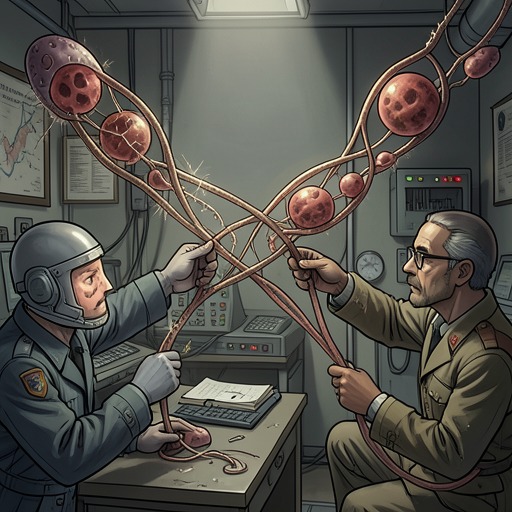
Chromosome
The Selfish GeneA chromosome is both part of the intricate arrangement that lets genes cooperate in building a body and the physical setting in which they are shuffled, inherited, and sometimes made to compete. The book uses chromosomes to connect the short-lived combinations found in individual organisms with the longer histories of genes, while showing how distortions in chromosome transmission can benefit a gene even when they harm the organism carrying it.
Structure and cooperation
A survival machine contains many thousands of genes, and its construction is a cooperative venture so intricate that the contribution of any one gene is difficult to separate from the rest. A gene can affect quite different parts of the body, while any one part may be influenced by many genes; the effect of one gene depends on its interactions with others. Some genes act as master genes, controlling clusters of other genes. The chromosome belongs to this interdependent system, not to a collection of isolated instructions that each independently builds a body.
The account cautions against taking expressions such as a gene for long legs or a gene for altruistic behaviour literally. No single gene builds a leg by itself: development is an interlocking process involving multiple genes and the external environment. The chromosome carries material whose effects emerge through that web of relationships. Its significance is therefore not that it makes genes solitary agents, but that it provides an organized physical context for genetic material whose effects are conditional and interactive.
Recombination and the gene’s continuity
Sexual reproduction mixes and shuffles genes, making each individual body a temporary vehicle for a short-lived combination. During the production of a sperm or egg, corresponding portions of paternal and maternal chromosomes detach and exchange places. This process, called crossing over, produces chromosomes that are mosaics of maternal and paternal genes rather than intact records of one parent’s contribution. The genes’ paths can cross and recross across generations even as the combinations assembled in particular individuals disappear.
The book’s distinction between the changing chromosome combination and the persistence of genes underlies its gene-centred argument. A gene is treated as a portion of chromosomal material that may last through enough generations to act as a unit of natural selection; its continuity lies in the succession of copies, not in the survival of one unchanged body or chromosome. Chromosomes thus carry genes through reproduction, but recombination means that the inherited arrangement is repeatedly remade.
The familiar image of genes as discrete pages in a plan has limits. Chromosomal material is a long string of nucleotide letters, and crossing over does not respect the boundaries between cistrons, the units defined by the start and end signals of a protein-coding message. A crossover can split within a cistron as well as fall between them. The book compares the material instead to matching rolls of ticker tape: corresponding stretches can be cut and exchanged regardless of the messages written on them. The chromosome is therefore not simply a binder of indivisible genetic instructions.
Inheritance and meiotic drive
In ordinary meiosis, the cell division that produces sperm or egg cells, either member of a pair of alleles has an equal chance of entering a given reproductive cell. Across many cells, each allele appears in half. But meiosis is a physical process, and genes can influence how it proceeds. A mutant gene that biases the process so that it is more likely to enter an egg than its allelic partner can spread at that partner’s expense. Such genes are called segregation distorters; their advantage in transmission is meiotic drive.
This is competition among genes sharing a body, rather than only competition among organisms. A gene can increase its own representation while imposing costs on the other genes in the same organism. The example of the mouse t gene makes the imbalance concrete: a male carrying one copy can be healthy, yet as many as 95 percent of his sperm may contain the t gene, against just 5 percent carrying the normal allele. The ordinary equal division of inheritance has been heavily skewed.
That transmission advantage can carry a severe cost. Mice with two copies of the t gene die young or are sterile. As the gene spreads, more individuals inherit it from both parents, and the local population may be driven extinct; the book notes evidence that wild mouse populations have gone extinct in the past through t-gene epidemics. Selection can favour a segregation distorter for its success in transmission even when its consequences for the organism, and ultimately the population, are disastrous.
Chromosomes, gene conflict, and escape routes
The contrast between cooperative development and genetic competition is central to the chromosome’s role in the book’s argument. Genes in an organism ordinarily share a route into future generations through sperm or egg. Their common dependence on that route helps align their interests, but it does not make them inseparable partners: meiotic drive shows that one can bias transmission against its alleles and the body’s welfare. The chromosome is both the framework for genetic cooperation and the physical machinery whose transmission can be manipulated.
The argument extends beyond genes incorporated in chromosomes. Some DNA fragments, including plasmids, can exist freely in cells, multiply, and splice themselves into a chromosome; they can also cut themselves out again. A fragment with this capacity suggests a possible departure from the conventional route through reproductive cells. The book speculates that a rebel stretch of human DNA might move between bodies in shed skin cells or cells transferred through kissing and caresses. This is presented as a possible route, not as a demonstrated event, and it sharpens the distinction between a gene’s physical location and the route by which its copies might reach the future.
Chromosomes therefore matter in two related but not identical ways: they house and transmit genes, and they mark the conventional reproductive channel through which genes in a body share a common future. Recombination makes the particular genetic combination temporary; segregation distortion reveals that transmission can be unfair; mobile DNA raises the possibility that some replicators may evade the usual channel. Together these cases make the chromosome a key object in the account of how genetic continuity, cooperation, and conflict coexist.